The latest Netanyahu US visit comes at a critical moment, as the Israeli prime minister travels to Washington despite an International Criminal Court arrest warrant, reshaping debates over Gaza, accountability, and US political support.
In the final days of 2025, Benjamin Netanyahu traveled to the United States, a visit that culminated in meetings with Donald Trump. The agenda reportedly included Iran, the next steps of the Gaza ceasefire plan, its second phase, and even discussions about a potential international stabilization force. Yet the real issue is not timing or talking points. The core issue is the political meaning of this visit.
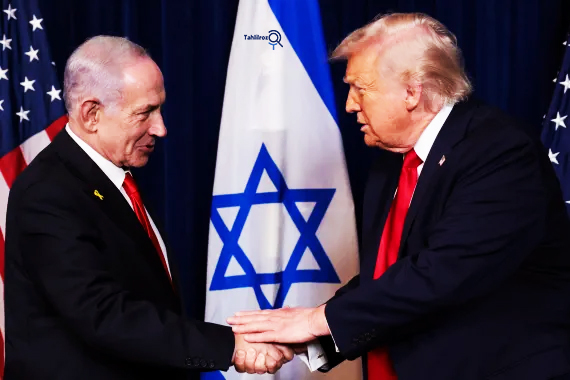
What makes this Netanyahu US visit particularly controversial is the existence of an ICC arrest warrant. Israel’s prime minister—despite an arrest warrant issued against him by the International Criminal Court (ICC)—once again walks into Washington, shakes hands, poses for photographs, and behind closed doors helps shape decisions about the future of Gaza and the wider region.
This marks Netanyahu’s fifth trip to the United States to meet Trump since the beginning of 2025. Such an unusually frequent pattern of visits carries a simple message: Israel does not make final strategic decisions without coordination with Washington—and Washington, despite its persistent human rights rhetoric (which, at least for Afghans, has long lost credibility), continues to function as a political and military partner in a project increasingly described by the world as occupation, forced transformation of realities on the ground, and systematic violation of Palestinian rights.
Historical Context: From Early Recognition to an Unwritten Security Pact
The repeated pattern of the Netanyahu US visit reflects a long-standing strategic alignment. If Netanyahu’s repeated visits to Washington are viewed merely as routine diplomacy, it is like trying to understand war by counting bullets while ignoring the politics behind the trigger. The US–Israel relationship is not a normal bilateral relationship between two states; it is a historical project that, since 1948, has been built on three pillars: political support, military backing, and ideological-security alignment.
Early Recognition
The United States was among the first countries to formally recognize Israel—at a moment when the world was entering the post–World War II order and the Palestinian question was becoming one of the central dilemmas of international politics.
Israel as a Strategic Asset
For Washington, a state capable of acting as a pro-Western political and military outpost in a turbulent region quickly became a strategic asset. Over the decades, US–Israel relations evolved beyond political sympathy into deep security synergy—manifested through technology transfers, joint military exercises, intelligence sharing, and sustained arms support.
Political Veto: Permanent Diplomatic Shield
One of the most crucial pillars of this relationship has been America’s diplomatic shield at the United Nations. Time and again, Washington has used political tools to reduce or neutralize the international costs faced by Israel at critical moments. This same mechanism is now being reproduced in the Gaza file—through behind-the-scenes pressure, management of criticism, and efforts to delegitimize international legal institutions.
Netanyahu Receives a Visa Despite an Arrest Warrant; the US Poses as a Human Rights Champion
The Netanyahu US visit has drawn intensified scrutiny precisely because it comes after the International Criminal Court issued an arrest warrant, placing Washington’s response under the spotlight. Let us avoid wordplay. The International Criminal Court, in its official documentation, categorizes Netanyahu’s case as involving allegations of war crimes and crimes against humanity. A dedicated ICC webpage outlines the nature of these accusations, and an arrest warrant was officially issued on November 21, 2024, explicitly referenced in formal statements.
The question, then, is straightforward: when a formal institution within the international legal system takes such action, how do its self-proclaimed defenders respond? The answer is alarming: not only indifference, but an outright attack on the justice mechanism itself.
In recent years, the United States has continued its pressure campaign against the ICC, including sanctions against officials and judges involved in related cases. Credible reports have documented these sanctions and the ICC’s response, in which the Court warned that such actions threaten judicial independence. Politically, the message is unmistakable: international justice is sacred when it targets Washington’s adversaries—but illegitimate and subject to coercion when it reaches its allies.
In this context, Netanyahu’s trip to the United States is no longer a routine diplomatic visit. It is a show of power—a demonstration that Israel, even under the shadow of an arrest warrant, continues to operate under the full political and security protection of the United States.
Iran, Military Drills, and the Fear Hidden Behind the Rhetoric
One of the most revealing aspects of Israel’s security doctrine is its simultaneous projection of two images. The first is that of a state that is always prepared, dominant, and deterrent. The second is that of a state perpetually anxious, constantly on alert, and deeply dependent on external guarantees.
Military exercises sit precisely at the intersection of these two narratives. Recent reports about Iranian military drills have framed them as demonstrations of power and readiness for defensive scenarios. Netanyahu has reportedly planned to focus on these drills and Iran’s missile capabilities during his US visit.
The reality is simple: if Iranian military exercises carry such weight in Israeli security calculations—if a single maneuver raises alert levels and compels Netanyahu to explain Israel’s fears to Trump—then the myth of absolute Israeli deterrence is just that: a propaganda myth. Netanyahu fears exercises; one can only imagine the consequences of a sustained, multi-layered, real confrontation with Iran.
The Political Meaning Behind Netanyahu’s Visit to Washington: A Mirror Washington Refuses to Face
Netanyahu’s fifth visit to the United States in less than a year is, above all, a mirror—one that places human rights slogans alongside the reality of political and military support, producing an image that Washington may find uncomfortable, but cannot deny.
Netanyahu, despite a heavy legal case at the international level, continues to enjoy de facto immunity.
The United States, instead of supporting legal accountability mechanisms, has moved toward pressuring and sanctioning the ICC.
Gaza faces the risk of a newly institutionalized occupation under new labels—from permanent presence to settlement expansion and annexation.
In the context of Iran and regional deterrence, the Netanyahu US visit serves as a platform to seek renewed guarantees. Iran has demonstrated that a direct confrontation could push the region to the brink of explosion, and Israel now relies on the American security umbrella more than ever to manage such a crisis.
Ultimately, the Netanyahu US Visit is more than a routine diplomatic engagement; it functions as a political endorsement with far-reaching consequences for Gaza and the region. These trips are not merely visits—they are signatures. Joint signatures of an alliance whose human cost on the ground is paid by Palestinians, and whose moral cost is borne by the credibility of Western human rights claims.
Saeed Mohammadi