Trump and Netanyahu met
US President Donald Trump hosted Israeli Prime Minister Benjamin Netanyahu at the White House on Tuesday, July 28. Both sides described the meeting as “positive” and reiterated their opposition to Iran acquiring nuclear weapons. In a video released after the meeting, Netanyahu said he had “the best conversation” with Trump, adding that the main focus of the talks was the “shared goal” of preventing Iran from acquiring nuclear weapons.
However, the 90-minute conversation between Trump and Netanyahu, which was held behind closed doors and was not followed by a joint press conference, did not dispel speculation about differences of opinion between the two sides.
Trump and Netanyahu and the Iran dispute
The US administration has said that it still wants to give diplomacy with Iran another chance after two weeks of massive military strikes and a ceasefire in April.
Israel, which launched military operations against Iran with the United States on February 28, did not participate in the new round of fighting in July.
Hours before meeting Netanyahu, Trump told Fox News about reports that Iran was strengthening its Pickaxe Mountain facilities: “Bibi doesn’t have to tell me that. He’s saying that because he wants me to stay involved.”
“I know exactly what’s going on at Pickaxe Mountain,” he added. “It’s not a big deal. If we don’t reach an agreement, we can easily destroy it.”
Other topics of Trump and Netanyahu’s discussion
In addition to Iran, Trump and Netanyahu were expected to discuss the implementation of the framework agreement between Israel and Lebanon, which was brokered by the United States to end the state of war between the two countries; an agreement whose implementation remains fraught with difficulties.
The Gaza war was also a major topic of discussion; Diplomatic efforts to begin rebuilding the Strip have yet to yield results, and the humanitarian situation in Gaza remains critical despite a fragile ceasefire in place since October 2025.
A show of unity ahead of the elections
Netanyahu’s trip to Washington comes as he prepares for parliamentary elections on October 27, with polls showing his popularity plummeting. Jonathan Freeman, an international relations expert at the Hebrew University of Jerusalem, told AFP the main purpose of the meeting was to send a message to Iran, Lebanon and other regional players that “there is no fundamental rift or difference between the United States and Israel.”
But it appears the meeting was just a show to hide the truth, and the differences between the two claimants to power and victory are more fundamental than they appear.
Tel Aviv’s concern about Washington’s possible softening
It seems that Trump has come to the conclusion that he must determine the task of the Strait of Hormuz as soon as possible and postpone the consideration of the Iranian nuclear file at least until after the US midterm elections in November. In practice, this decision will postpone the consideration of this file until after the Israeli elections in October.
From Trump’s perspective, the opening of the Strait of Hormuz based on US conditions and considerations is equivalent to a strategic victory; but failure to achieve this goal will practically mean that Iran has been able to impose its conditions on the equations and gain the upper hand in this confrontation.
Most Israeli analysts believe that Netanyahu had requested a meeting with Trump for electoral purposes; a meeting that could end rumors about a crisis in relations between the two and provide him with images and messages that could be used in the electoral competition and efforts to maintain power.
For Netanyahu, the Iranian nuclear issue is his “lifetime project.” He and his close associates believe that Trump is now on the verge of making final decisions on the issue. Therefore, the Israeli prime minister is trying to ensure that these decisions will be in Israel’s interests or at least will not cause it great harm and cost.
Perhaps Israel’s greatest concern is that Trump will take a softer approach on the nuclear issue in exchange for Iran’s flexibility on the Strait of Hormuz issue. This is while, from Israel’s perspective, the Strait of Hormuz is important not as an independent issue, but mainly because it could affect Iran’s nuclear program and missile capabilities.
Netanyahu’s credibility declines in Washington
Benjamin Netanyahu’s position in Washington today is significantly different from his position on his previous trip. In a previous meeting, he presented his plan for war with Iran to Trump, promising that the Islamic Republic would be overthrown through a four-pronged plan that included assassinating leaders, deploying Kurdish forces, launching a massive propaganda campaign, and introducing a symbolic figure.
However, only the part of that plan involving the assassination of the Islamic Republic’s leader and a number of Iranian commanders was implemented, and ultimately the entire project failed. This failure also severely undermined confidence in Netanyahu’s assessments and promises and called into question the credibility of his analyses.
Therefore, during a recent meeting at the White House, members of Trump’s team more carefully assessed Netanyahu’s words and proposals to determine how well they aligned with American interests and the strategic priorities of the United States government.
The hidden divide between Trump and Netanyahu on Iran
After the meeting, both Trump and Netanyahu claimed that their talks were successful and fruitful, and emphasized their complete alignment of positions.
However, regardless of this official narrative, the differences between the two sides remain. Netanyahu continues to call for an escalation of tensions until reaching an all-out war against Iran; an approach that is supported by a significant part of Israeli public opinion as well as many of the country’s military and political elites.
In contrast, Trump, above all, seeks diplomatic solutions and avoiding the spread of the conflict; a view that is also consistent with the majority of American public opinion and a significant number of senior officials in Washington.
In addition, the political motivations of Trump and Netanyahu are not the same. Netanyahu is desperately seeking a political achievement on the eve of an election that polls indicate is likely to defeat him and lose the prime ministership.
From this perspective, the outcome of these developments is not simply a political issue for him, but is tied to his personal future and political destiny.
In contrast, Trump is not facing such a personal and decisive battle. He is engaged in an election that could determine the fate of his party’s majority in Congress; an issue that is undoubtedly important for his administration, but not as crucial and decisive for the political future of the US president as what Netanyahu is facing.
Trump cannot ignore the fact that Netanyahu has become a deeply unpopular figure in American public opinion these days, and many accuse him of being influenced by the Israeli prime minister in his decisions. Perhaps this explains, to some extent, the cold reception Netanyahu received in the White House and his quiet entry through the back door.
In a poll published by the Economist magazine on American public opinion, 49 percent of respondents supported the arrest of Netanyahu in execution of the International Criminal Court’s verdict, while only 27 percent opposed such a measure.
In addition, the results of numerous polls show that the majority of American citizens have a very negative view of Israel and Netanyahu personally. Also, most Americans oppose the escalation of conflicts and the spread of war and call for a complete cessation of military operations in the Persian Gulf region.
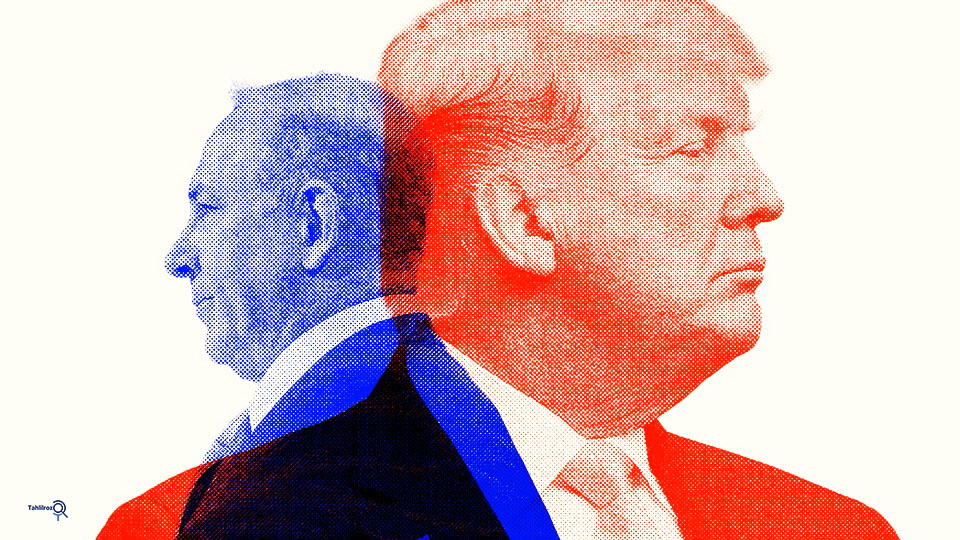
Conclusion: Trump and Netanyahu, hand in hand in the quagmire of a failed war with Iran
Netanyahu’s main goal was to convince Trump to return Israel to war with Iran; but the US president neither presented a clear strategy for continuing the war nor agreed to Israel’s re-engagement in the conflict. Israeli sources say Trump himself may not yet know what approach to take towards Iran; but a more worrying possibility is that he no longer cares as much about Netanyahu’s demands and concerns as he did in the past.
Trump had emphasized before the meeting that he would make the decision to attack a suspected nuclear facility in Iran personally and would not need Netanyahu’s advice. Some Israeli sources say he is unhappy with the idea that Netanyahu has dragged the US into a failed war. Trump has reduced Netanyahu to “his real size, maybe smaller,” according to a former Israeli official, and Israel now looks more like a government dependent on American support than ever before.
Israeli defense officials had also told Netanyahu before the trip that the chances of Trump returning to full-scale war were slim and that sporadic clashes would not change the course of the war. For this reason, Netanyahu played it safe in Washington, not threatening Iran and leaving the final decision to Trump. “Netanyahu gave them no excuses, but they gave him nothing either; it was more for the record,” said one of his aides.
Ultimately, the meeting between Trump and Netanyahu may have been presented as a demonstration of unity, but beneath the carefully managed images and diplomatic language lies a much more complicated reality. The war against Iran has failed to produce the decisive outcome that its architects once anticipated, while Tehran has demonstrated that it can still impose significant costs, maintain its missile capabilities, and use its strategic position around the Strait of Hormuz as a powerful source of leverage.
Trump now appears increasingly focused on finding a way out of the confrontation on terms that can be presented as a victory, while Netanyahu remains committed to an approach that risks dragging Washington back into a conflict it may no longer be willing to pursue. In this sense, the real divide between the two leaders is not merely over tactics or timing; it is over how to deal with a regional power that has survived the pressure, disrupted the calculations of its adversaries, and demonstrated that defeating Iran is considerably more difficult than declaring victory over it.
Mohsen Shahrafiee